Choosing Small on Purpose: Why Skilled Americans Are Bypassing Tokyo for Japan's Regional Gems
For decades, the standard script for an American moving to Japan read predictably: land at Narita, find a share-house in Shibuya or Shinjuku, and work your way into the city's relentless professional ecosystem. Tokyo's gravitational pull was simply too strong to resist—or so the logic went. Yet a measurable shift is underway. A younger, more deliberate wave of American professionals is reading that script, setting it aside, and booking onward tickets to places most of their peers cannot locate on a map.
The destinations they are choosing—Kanazawa in Ishikawa Prefecture, Takayama in the Hida highlands of Gifu, Nagicho in Okayama, and dozens of similarly sized communities across the archipelago—share a common denominator: they are places that once hemorrhaged population and talent, and are now engineering creative strategies to reverse that tide. For American arrivals, the timing has produced an unusual alignment of municipal incentive and personal opportunity.
The Supply Side of Japan's Regional Talent Push
Japan's demographic challenge is well documented. Rural and mid-sized prefectures have watched young residents migrate toward metropolitan centers for generations, leaving behind aging populations, underutilized infrastructure, and municipal budgets strained by shrinking tax bases. The national government's regional revitalization initiative—known broadly as chihou sousei—has channeled funding and policy flexibility toward localities willing to experiment with solutions.
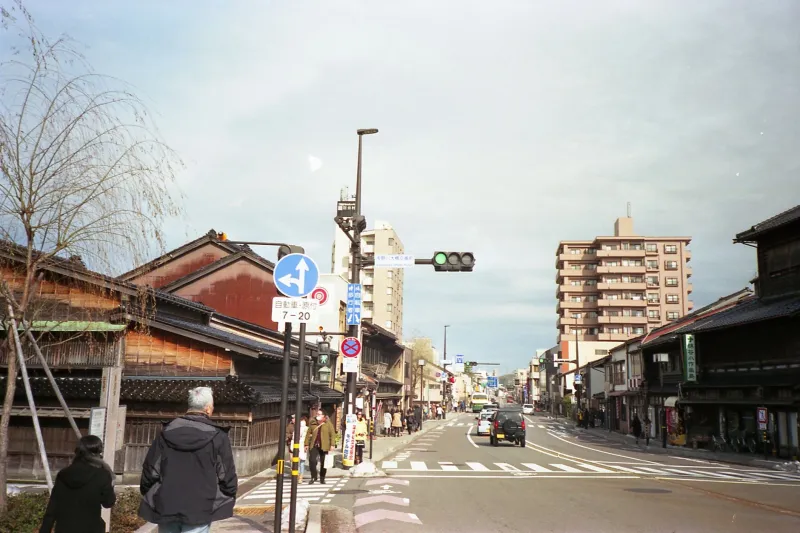
What has emerged in a number of forward-thinking communities is a surprisingly sophisticated foreign talent recruitment apparatus. Kanazawa, often described as Kyoto's less-touristed sibling, has positioned itself as a creative industries hub, marketing its preserved samurai and geisha districts alongside a genuine art and design scene centered on the 21st Century Museum of Contemporary Art. The city offers subsidized workspace, networking infrastructure for entrepreneurs, and municipal staff who speak enough English to navigate the administrative onboarding process with foreign residents.
Takayama takes a different approach, leaning into its reputation as one of Japan's best-preserved Edo-period merchant towns. Remote work infrastructure investments—fiber connectivity in areas where dial-up was standard not long ago—have made it viable for knowledge workers to operate from the town's centuries-old machiya townhouses without sacrificing professional output. Nagicho, a small municipality in Okayama Prefecture that has received considerable attention for its aggressive depopulation-reversal programs, has gone further still, offering subsidized housing, startup grants, and in some cases direct stipends to qualified individuals willing to relocate and contribute to local economic life.
What American Professionals Are Actually Finding
Marcus T., a UX designer from Portland, Oregon, spent six months in Tokyo before relocating to Kanazawa three years ago. He describes the transition not as a retreat but as an upgrade. "In Tokyo, I was one of roughly ten thousand designers competing for the same freelance contracts," he explains. "In Kanazawa, I became the person local businesses called when they needed someone who understood both digital product design and could communicate with international clients. The scarcity worked entirely in my favor."
His experience reflects a dynamic that regional economists have begun to study seriously: the compression of competition in smaller markets can function as a structural advantage for skilled newcomers, particularly those whose capabilities are scarce locally. An American software developer, a licensed architect, a certified financial planner, or a fluent English-speaking marketing strategist enters a regional Japanese market with a differentiated profile that the same individual would struggle to establish in Tokyo's saturated professional landscape.
Beyond professional calculus, the quality-of-life arithmetic is striking. Monthly rent for a spacious, traditional-style residence in Takayama runs a fraction of what a compact Tokyo apartment commands. Commute times measured in minutes rather than hours free up recoverable portions of each workday. Access to locally grown produce, clean mountain air, and intact community social structures provides a living standard that many Americans associate more with idealized rural life back home than with the reality of it.
Jennifer M., a former New York-based nonprofit program director who relocated to a town in Tottori Prefecture, frames her choice in explicitly community-oriented terms. "I wanted to actually know my neighbors. I wanted to participate in something, not just consume it," she says. "In a depopulating town, you are genuinely needed. That is not a feeling most Americans associate with moving abroad."
Integration as a Two-Way Process
It would be misleading to portray regional Japan as uniformly welcoming or administratively frictionless for foreign arrivals. Language remains a significant barrier in many communities, and the social rhythms of tight-knit rural towns can feel impenetrable to outsiders who have not invested time in learning local customs and even basic Japanese. The Americans who thrive in these environments consistently describe a willingness to participate in community life on the community's own terms—attending neighborhood association meetings, volunteering for festival preparation, shopping at local establishments rather than defaulting to online retail.
Municipal governments in towns with active foreign recruitment programs have generally recognized this integration challenge and are developing resources to address it. Some communities now offer Japanese language classes specifically structured for working adults, while others have established buddy systems pairing new foreign residents with local mentors who can ease the social and administrative transition.
The economic implications for regional Japan are beginning to attract serious academic and policy attention. When a skilled foreign professional establishes a business in a depopulating town, the ripple effects extend beyond that individual's tax contribution. They tend to attract additional remote workers and entrepreneurs through peer networks, create demand for local services, and in some cases introduce skills and business models that transfer to local enterprises over time.
What This Means for Americans Considering the Move
For American professionals weighing a Japan relocation, the conventional wisdom that Tokyo is the only viable landing point deserves scrutiny. The infrastructure gaps that once made regional Japan impractical for knowledge workers have narrowed considerably. The administrative support available in communities actively recruiting foreign residents has improved. And the professional opportunity that comes from entering a less saturated market—combined with municipal incentives that Tokyo has no reason to offer—creates a value proposition that merits genuine evaluation.
The Americans who have made this counterintuitive choice are not uniformly younger digital nomads or lifestyle experimenters, though some fit that description. They include mid-career professionals reassessing priorities, entrepreneurs seeking lower-cost operating environments, and creatives drawn to the cultural richness and craft traditions that smaller Japanese cities preserve more intact than the capital does.
What they share is a willingness to look past the obvious and ask what a place that needs them might offer in return. In Japan's regional towns, the answer turns out to be more substantive than most expected.
Kaigot Japan Local maintains a regularly updated directory of regional municipalities with active foreign resident support programs. Consult our Expat Living resources for practical guidance on relocation, housing, and administrative registration in specific prefectures.